
Background
The previous national plan expired in 2024. It is unclear when a new plan is due.
The primary office is The Coordination Office for Prevention of Trafficking in Persons under the Ministry of Internal Affairs.
The Coordination Office for Prevention of Trafficking in Persons coordinates and cooperates with the Ministry of Gender, Labour and Social Development and Uganda Police Force.
The Coordination Office for Prevention of Trafficking in Persons publishes an annual report. The last annual report was in 2022.
Data on prosecutions and perpetrators is available on an ongoing basis via an innovative platform, TIPMAP, which is run by the Director of Public Prosecutions.
The annual report contains information about trafficking cases against public officials.
There are National Referral Guidelines for Management of Victims of Trafficking in Uganda for coordinating efforts between NGOs.
In 2025, the Ministry of Internal Affairs issued a National Migration Policy.
The Ministry of Gender, Labour and Social Development runs the External Employment Management Information System, EEMIS, so that all jobs and recruitment companies are vetted and approved by the Ministry.
Criminal enforcement against corporations benefiting from exploitation in supply chains is very limited.
The Financial Intelligence Authority of Uganda published a report on the role of banks and fintech against human trafficking.
The budget information for The Coordination Office for Prevention of Trafficking in Persons is available in Ministry of Internal Affairs Budget Estimates.
Other Key Factors
According to the Department of Refugees, Uganda is currently host to 1,741,331 refugees and asylum seekers – comprising of 1,693,311 refuges and 48,020 asylum seekers.
Freedom of association and collective bargaining is lawful and active but concerns have been expressed by NGOs that these rights are threatened.
Wage theft is significant problem.
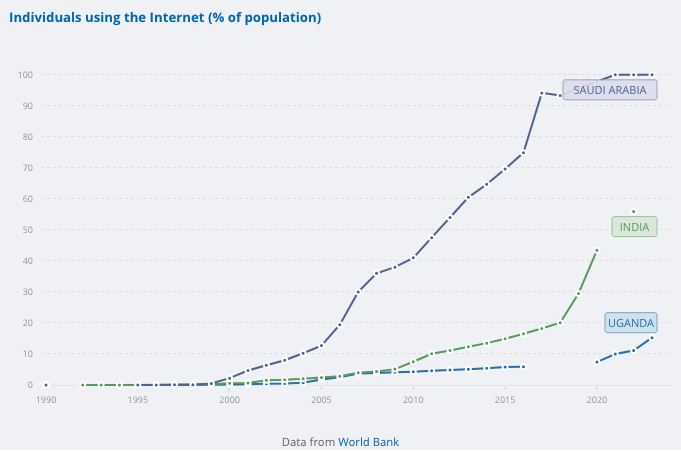
To understand Uganda’s situation more fully, we show the percentage of the population using the internet in Uganda, along with the highest usage and lowest usage countries amongst the G20 members (Saudi Arabia and India).
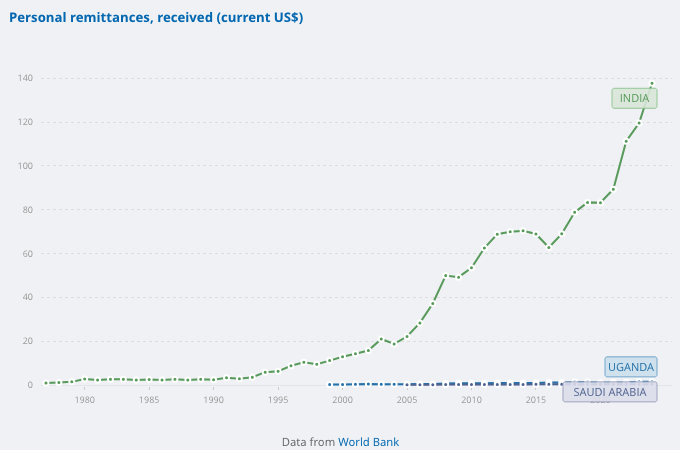
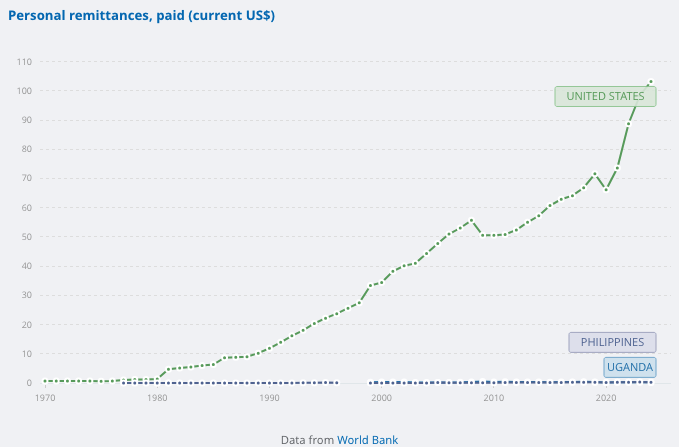
Uganda’s remittances are also shown with the respective highest and lowest inflow remittance countries in the G20 (India/Saudi Arabia) and the highest and lowest outflow countries in the G20 (US/Philippines). Keep in mind that remittance estimates are often an under count of actual remittance volume.(Graph unit is in Billion US$)
Uganda’s Role in the Global Economy and Its Supply Chains
Trade flows from The Observatory of Economic Complexity. Remittance from the World Bank.