
Background
There is currently no national plan or strategy to combat modern slavery. The last national action plan was 2014.
The Home Office is the government ministry providing the strategic leadership and the majority of funding.
The closest document to a national plan is the National Strategy document of recommendations published by the current Independent Anti-Slavery Commissioner.
The government has developed a sophisticated National Referral Mechanism handling thousands of cases per year. At present, there is a backlog of referrals.
A complex arrangement of government departments, agencies, offices and third-party stakeholders (such as civil society service providers and university researchers), comprise the anti-modern slavery ecosystem in the United Kingdom. However, the objectives, courses of action and measurements of performance and impact remain difficult to identify without a published national plan or strategy.
No regular annual national progress report on anti-modern slavery activities is available.
Scotland and Northern Ireland do publish separate information and provide some separate funding. For example, Scotland recently published their “Trafficking and Exploitation Strategy: fifth progress report” covering the period 2022 - 2025.
Two existing agencies/offices, the Gangmasters & Labour Abuse Authority (to become the Fair Work Agency) and the Modern Slavery and Organized Immigration Crime Programme publish annual reports of their work.
The Home Office publishes regular data and information concerning the progress of the National Referral Mechanism and victim care services.
The Crown Prosecution Service publishes quarterly statistics which include their work relating to the crimes of modern slavery and human trafficking.
The United Kingdom has highly complex and diverse supply chains.
Criminal enforcement against corporations benefiting from exploitation in supply chains is very limited.
Disclosure statements are required for certain size corporations under the current legislation but there is no enforcement action. See below for legal case against the National Crime Agency.
The UK Financial Intelligence Unit does analyze suspicious activity reports on human trafficking, however it has not published any typologies.
From the funding information disclosed, there is an average of GBP102 million per annum made available for the various anti-modern slavery government departments, agencies and offices and non-governmental stakeholders. The majority of this funding goes to victim services and the UK National Referral Mechanism.
There is no regular disclosure or reporting on funding via any regular and consistent reporting mechanism.
Other Key Factors
The Court of Appeal judged in favor of the World Uyghur Congress’s legal challenge against the National Crime Agency (as the UK government) for the latter’s failure to investigate potential money laundering offenses arising from cotton imports from suppliers in China’s Xinjiang Uyghur Autonomous Region. The National Crime Agency had declined to use its investigatory powers.
Wage theft is an issue in the UK.
Freedom of association is lawful and active.
The United Kingdom continues to experience challenges arising from human smuggling, human trafficking and illegal migration from Europe.
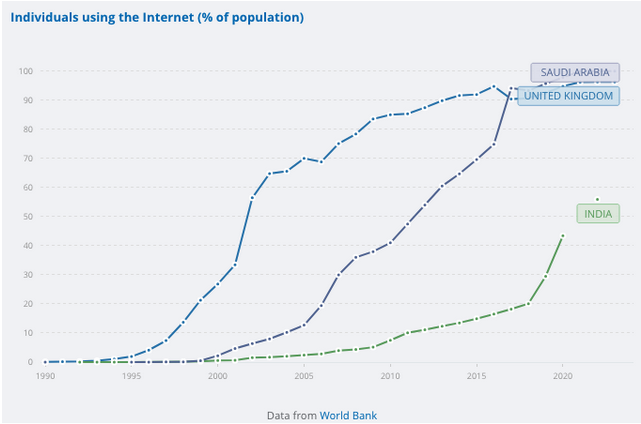
To understand the UK’s situation more fully, we show the percentage of the population using the internet in the UK, along with the highest usage and lowest usage countries amongst the G20 members (Saudi Arabia and India).
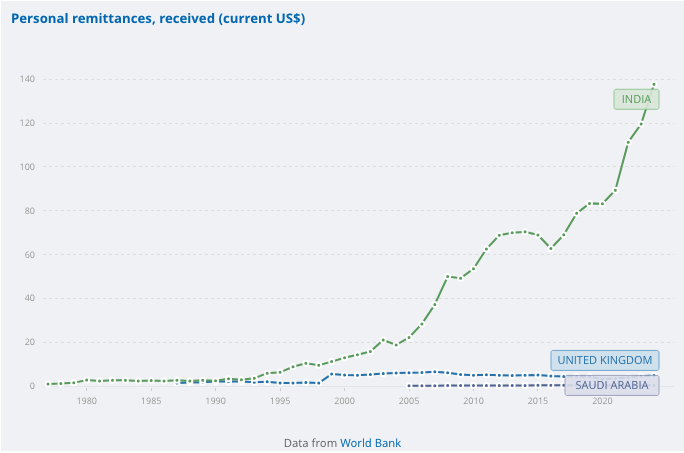
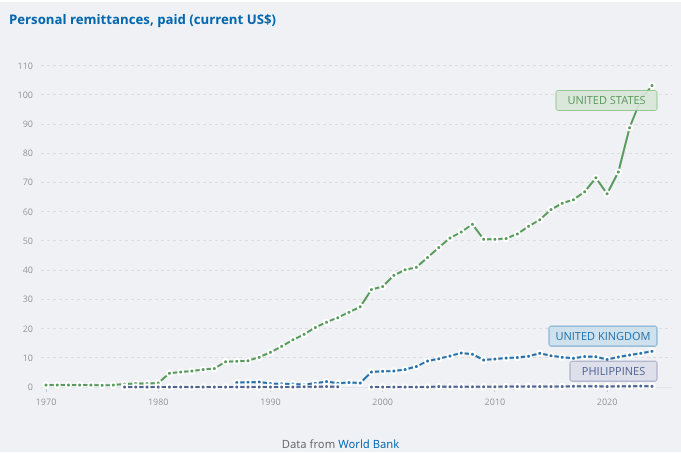
UK’s remittances are also shown with the respective highest and lowest inflow remittance countries in the G20 (India/Saudi Arabia) and the highest and lowest outflow countries in the G20 (US/Philippines). Keep in mind that remittance estimates are often an under count of actual remittance volume.(Graph unit is in Billion US$)
UK’s Role in the Global Economy and Its Supply Chains
Trade flows from The Observatory of Economic Complexity. Remittance from the World Bank.