
Background
Ghana has a current national action plan which runs from 2022 - 2026 issued by the Ministry of Gender, Children and Social Protection.
There is also a national action plan for the elimination of child labour which runs from 2023-2027.
The agencies leading the work against exploitation are the Anti-Human Trafficking Unit, a part of the Ghana Police Service, Ministry of Women and Children’s Affairs (MOWAC), Department of Social Welfare (DSW), Ghana Immigration Service (GIS) and the Attorney General’s Office.
In 2023, the Ministry of Employment and Labour Relations published the Guidelines and Protocols for Establishing Child Labour Free Zones (CLFZs).
There are no publicly available and accessible annual reports. There are statistics and information technology units but access is difficult.
There are no publicly available and accessible data on victims and perpetrators.
Criminal enforcement against corporations benefiting from exploitation in supply chains is very limited.
It is not clear that the financial intelligence unit in Ghana, the Financial Intelligence Centre, focuses on monitoring proceeds and transactions arising from exploitation.
With a few exceptions, the reporting of dedicated funding for combatting exploitation is publicly disclosed.
Other Key Factors
Wage theft is a significant issue in Ghana.
78% of employment is informal giving rise to the threat of wage theft without any formal means of redress.
Freedom of association and collective bargaining are lawful and active.
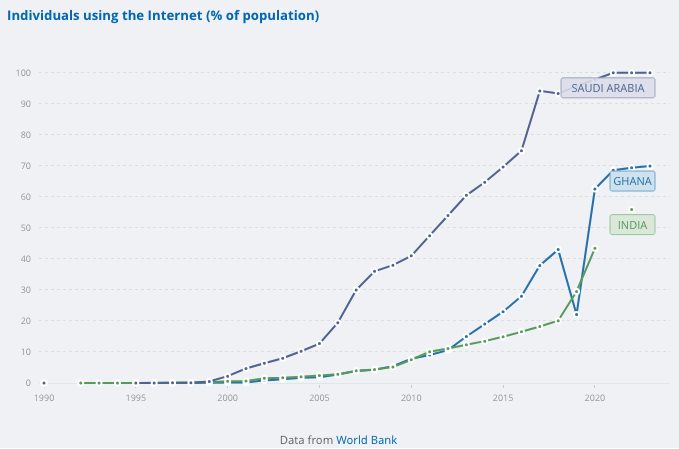
To understand Ghana’s situation more fully, we show the percentage of the population using the internet in Ghana, along with the highest usage and lowest usage countries amongst the G20 members (Saudi Arabia and India).
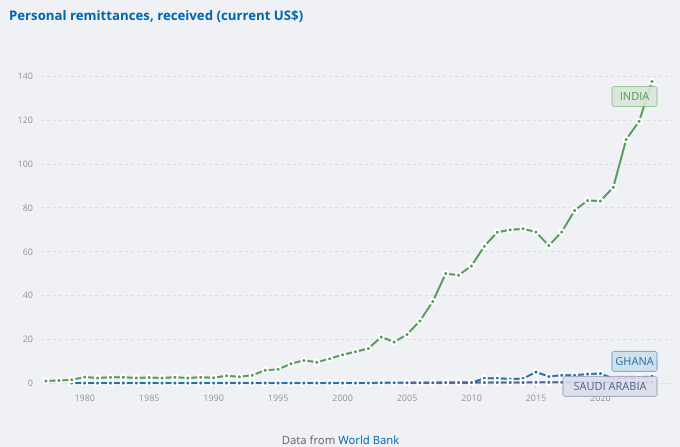
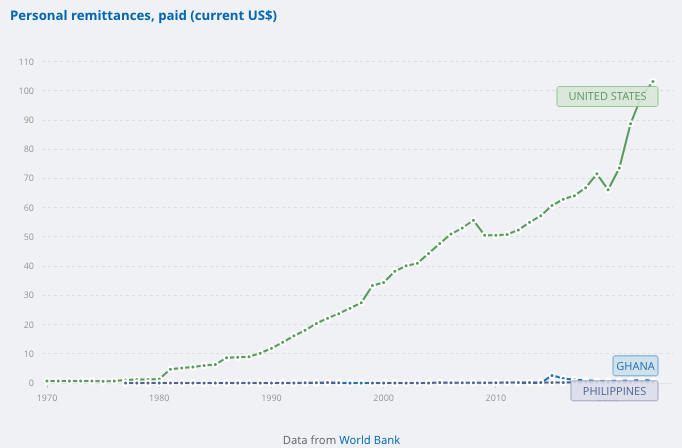
Ghana’s remittances are also shown with the respective highest and lowest inflow remittance countries in the G20 (India/Saudi Arabia) and the highest and lowest outflow countries in the G20 (US/Philippines). Keep in mind that remittance estimates are often an under count of actual remittance volume.(Graph unit is in Billion US$)
Ghana’s Role in the Global Economy and Its Supply Chains
Trade flows from The Observatory of Economic Complexity. Remittance from the World Bank.