
Background
There is no recent revision or new national action plan to combat exploitation.
In 2016 the Ministry of Women and Child Development published “A Comprehensive Scheme for Prevention of Trafficking and Rescue, Rehabilitation and Re-Integration of Victims of Trafficking for Commercial Sexual Exploitation”.
In 2023, Standing Committee on Labour, Textiles and Skill Development published the Fifty-Second Report on ‘National Policy on Child Labour – An Assessment’.
The government implements schemes under the Nirbhaya Fund to Enhance Women's Safety and Security.
By 2025, the government had launched a total of 827 Anti-Human Trafficking Units (AHTUs) across the country. These are set up for prevention of human trafficking and victim support.
14,658 Women Help Desks have been established in police stations nationwide with 13,743 headed by women police officers.
802 One Stop Centres are functional across 36 States/UTs with over 1 million women assisted so far.
Press Information Bureau Women Helpline is operational in 35 States/UTs (except West Bengal); over 21 million calls handled and 8.4 million women assisted.
Press Information Bureau 790 Fast Track Special Courts (FTSCs) approved since 2019.
745 including 404 exclusive Protection of Children from Sexual Offences (POCSO) Act courts operational in 30 States/UTs; more than 3,06,000 cases of rape / POCSO offences disposed.
Crime statistics are publicly available and accessible.
Criminal enforcement against corporations benefiting from exploitation in supply chains is very limited.
Annual reports by the Indian financial intelligence unit, FIU-IND, do not provide any data or typologies on human trafficking.
Some dedicated allocations and spending on specific programs and activities relating to combating exploitation are publicly available and accessible. Budget information and data of shared contributions of ministries and departments responsible combating trafficking is not available.
Other Key Factors
Focus on exploitation of men is very limited.
Wage theft is prevalent across India.
88% of employment is informal giving rise to the threat of wage theft without any formal means of redress.
Freedom of Association and collective bargaining are lawful and active though face restrictions in practice.
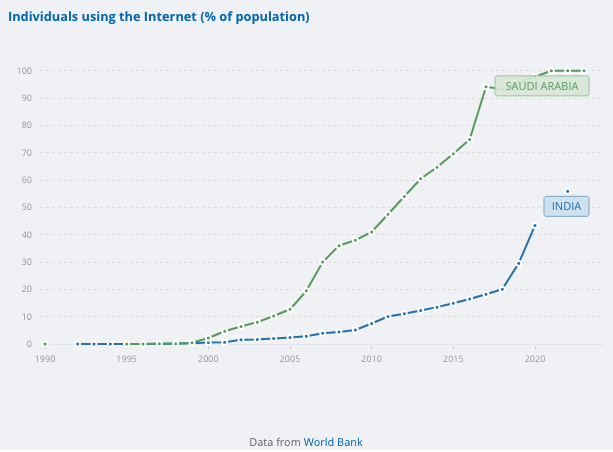
To understand India’s situation more fully, we show the percentage of the population using the internet in India. India is the lowest usage country amongst the G20 members (Saudi Arabia being the highest).
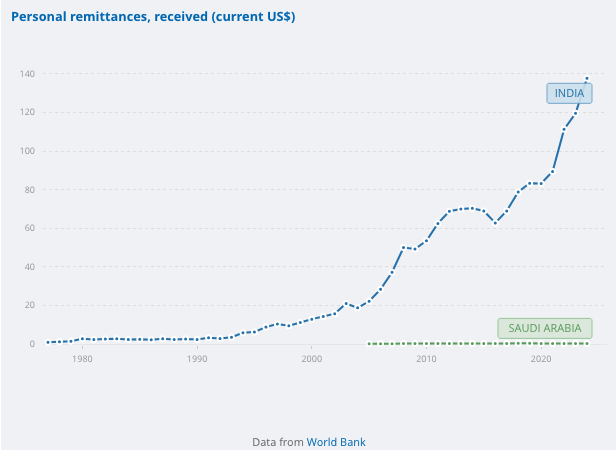
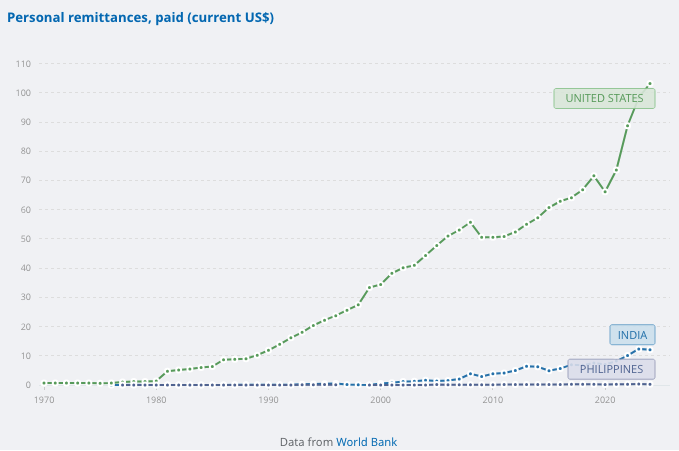
India’s remittances are also shown. India is the highest inflow remittance countries in the G20 (Saudi Arabia is the lowest). India’s outflow remittance is shown with the highest and lowest outflow countries in the G20 (US/Philippines). Keep in mind that remittance estimates are often an under count of actual remittance volume. (Graph unit is in Billion US$)
India’s Role in the Global Economy and Its Supply Chains
Trade flows from The Observatory of Economic Complexity. Remittance from the World Bank.