
Background
The government has issued a number of national plans to address exploitation. The National Human Rights Program expired in 2024 but did set objectives which included actions that would directly and indirectly prevent and protect vulnerable people from exploitation. More specifically, the government has the National Program for the Protection of Girls, Boys and Adolescents (PRONAPINNA) and National Program for Prevention, Punish and Eradicate Crimes in Matters of Trafficking in Persons and for the Protection and Assistance of Victims of the Crimes.
The Intersecretarial Commission to Prevent, Punish and Eradicate Crimes of Trafficking in Persons and to Protect and Assist Victims of these Crimes and the Intersecretarial Commission for the Prevention and Eradication of Child Labor and the Protection of Working Adolescents provide direction for a wide range of ministries, departments, agencies and offices.
Important ministries and departments are Special Prosecutor's Office for Crimes of Violence Against Women and Human Trafficking (FEVIMTRA) under the Attorney General’s Office (FGR), Ministry of Interior (SEGOB), Ministry of Labour and Social Welfare (STPS), Executive Commission for Victim Assistance (CEAV), Executive Secretariat of the National Public Security System and Unidad de Intelligencia Financiera (FIU).
There is an annual progress report published by Intersecretarial Commission to Prevent, Punish and Eradicate Crimes of Trafficking in Persons and to Protect and Assist Victims of these Crimes.
The government developed the National System on Trafficking in Persons (SINTRA) to manage and retain records and data on exploitation.
Mexico has a dedicated human trafficking hotline.
Mexico’s supply chains are primarily based on the relationship with the United States though there are trade relationships with other countries in the Americas and China.
Mexico is obviously a participant in USMCA and therefore works with the U.S. government and United States Trade Representative via the Rapid Response Mechanism.
Criminal enforcement against corporations benefiting from exploitation in supply chains is very limited. The Ministry of Labour and Social Welfare (STPS) is repsonsible for monitoring labor practices
Data on victims and perpetrators is publicly available and accessible but not necessarily current.
The financial intelligence unit, Unidad de Intelligencia Financiera, monitors financial transactions relating to exploitation and has published two typology documents on trafficking.
Budget information and data concerning ministries and departments are available and accessible but dedicated allocations and spending on specific programs and activities related combating exploitation are not consistently identified.
Other Key Factors
Mexico has well documented and sizable challenges with organized crime.
There are significant issues with disappearing persons and femicide though the intentional homcide rate is higher for men.
Poverty is a significant challenge with a high level of inequality.
Wage theft is significant challenge, for example underreporting wages for social security fraud to reduce contributions and no payments for overtime.
Freedom of association and collective bargaining is lawful and active, particularly after the creation of Federal Center for Labor Conciliation and Registry (CFCRL) encouraged by USMCA. However, lack of resources and corruption threaten progress.
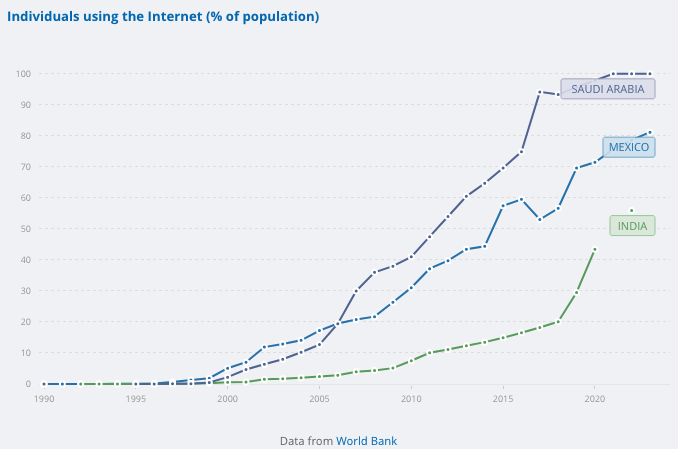
To understand Mexico’s situation more fully, we show the percentage of the population using the internet in Mexico, along with the highest usage and lowest usage countries amongst the G20 members (Saudi Arabia and India).
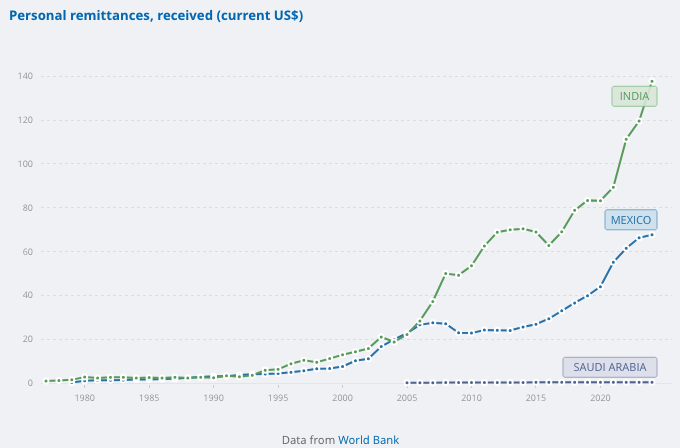
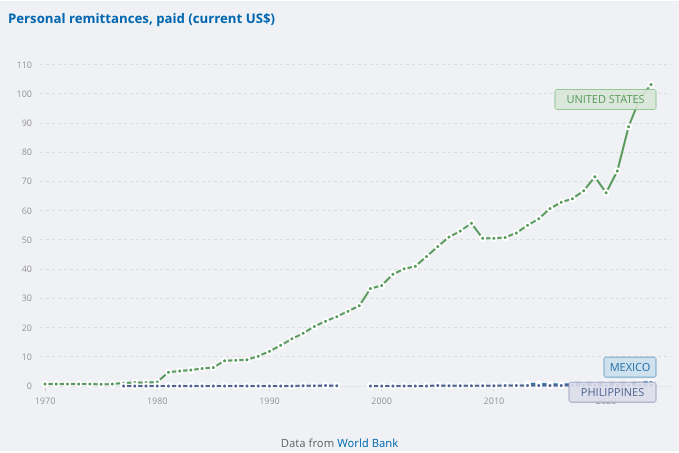
Mexico’s remittances are also shown with the respective highest and lowest inflow remittance countries in the G20 (India/Saudi Arabia) and the highest and lowest outflow countries in the G20 (US/Philippines). Keep in mind that remittance estimates are often an under count of actual remittance volume.(Graph unit is in Billion US$)
Mexico’s Role in the Global Economy and Its Supply Chains
Trade flows from The Observatory of Economic Complexity