
Background
The five year national plan which expired in 2024 is in the process of being renewed.
Public Safety Canada is the leading agency for anti-human trafficking activities working in cooperation with a range other government institutions.
The last annual progress report was 2023 by Statistics Canada.
In 2025, Public Safety Canada published the National Strategy to Combat Human Trafficking 2023-2025 Report assessing the effectiveness of the implementation of the national plan.
In 2025, the government appointed its first Chief Advisor to Combat Human Trafficking.
The government funds an NGO, the Canadian Center to End Human Trafficking, to run the national hotline. The Center operates a referral network and publishes annual data.
Government data is made publicly accessible and available via Statistics Canada publications.
The government published the Annual Report to Parliament on the Fighting Against Forced Labour and Child Labour in Supply Chains Act in 2025.
The Fighting Against Forced Labour and Child Labour in Supply Chains Act requires certain government institutions and entities to report on their efforts to prevent and reduce risks of forced labour or child labour in their supply chains. The report in 2025 outlines the risk and actions taken by respondents to the Supply Chains Act.
The majority of Canada’s supply chains link to the United States and so its efforts are connected to this relationship, most particularly through the United States Mexico Canada Agreement (USMCA).
Criminal enforcement against corporations benefiting from exploitation in supply chains is very limited.
FINTRAC, Canada’s financial intelligence unit, has updated its indicators for sex exploitation. It has published two recent annual reports containing information on laundering of proceeds from human trafficking.
Since 2016, FINTRAC has run PROJECT PROTECT which focuses on combating human trafficking for sexual exploitation and labour trafficking. There is limited information about profiting from exploitation in supply chains, such as wage theft.
Canada reports on modern slavery risk in government procurement.
Some information about dedicated budgets for activities combating exploitation are publicly available and accessible.
Other Key Factors
Freedom of association is lawful and active.
Wage theft is an issue in Canada but with very limited data and reporting.
An key issue shared by Canada with other countries in the Americas is the risk faced by indigenous communities and peoples.
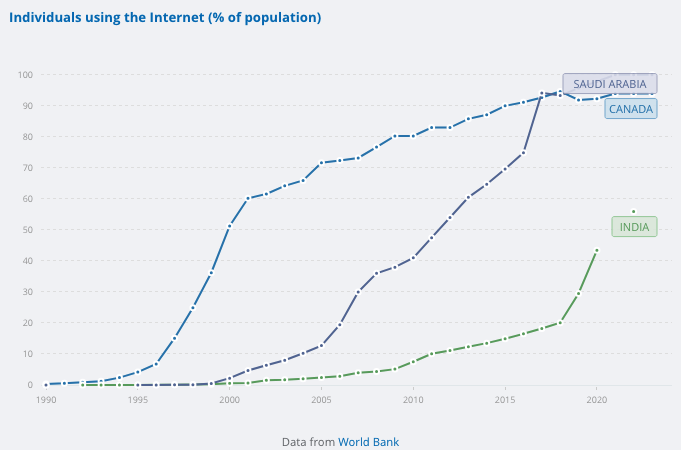
To understand Canada’’s situation more fully, we show the percentage of the population using the internet in Canada, along with the highest usage and lowest usage countries amongst the G20 members (Saudi Arabia and India).
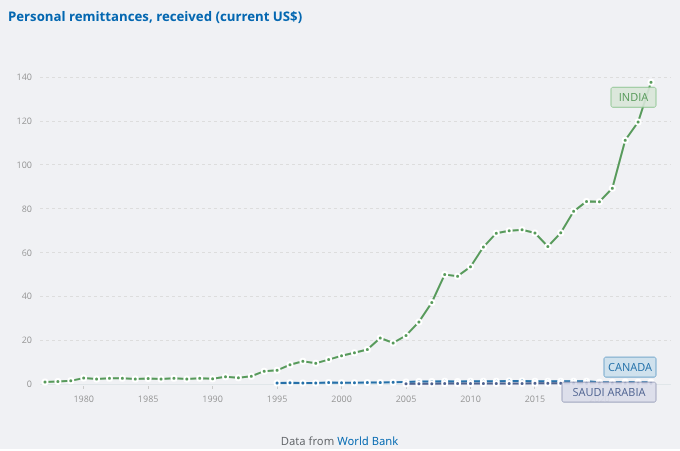
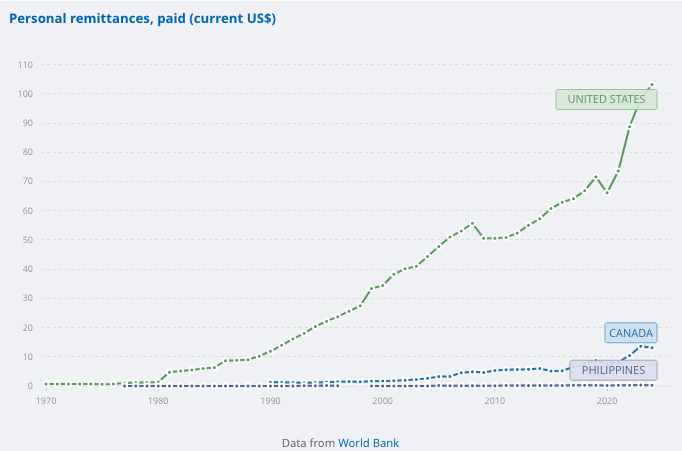
Canada’s remittances are also shown with the respective highest and lowest inflow remittance countries in the G20 (India/Saudi Arabia) and the highest and lowest outflow countries in the G20 (US/Philippines). Keep in mind that remittance estimates are often an under count of actual remittance volume.(Graph unit is in Billion US$)
Canada’s Role in the Global Economy and Its Supply Chains
Trade flows from The Observatory of Economic Complexity. Remittance from the World Bank.